
Crowns and bridges · Widney Dental, Knowle
A broken tooth rebuilt. A gap filled.
A crown covers a tooth that is broken, heavily filled or root-filled and gives it back its shape and strength; a bridge fills the gap where a tooth is missing, held by the teeth either side. Both are made by a dental laboratory to match your teeth, over two visits. Privately a porcelain crown is £450 – £550 and a bridge £500 – £550 a unit; on the NHS both come within Band 3, £332.10.
★★★★★ 4.8 from 175 Google reviews · NHS and private
In short
Crown or bridge?
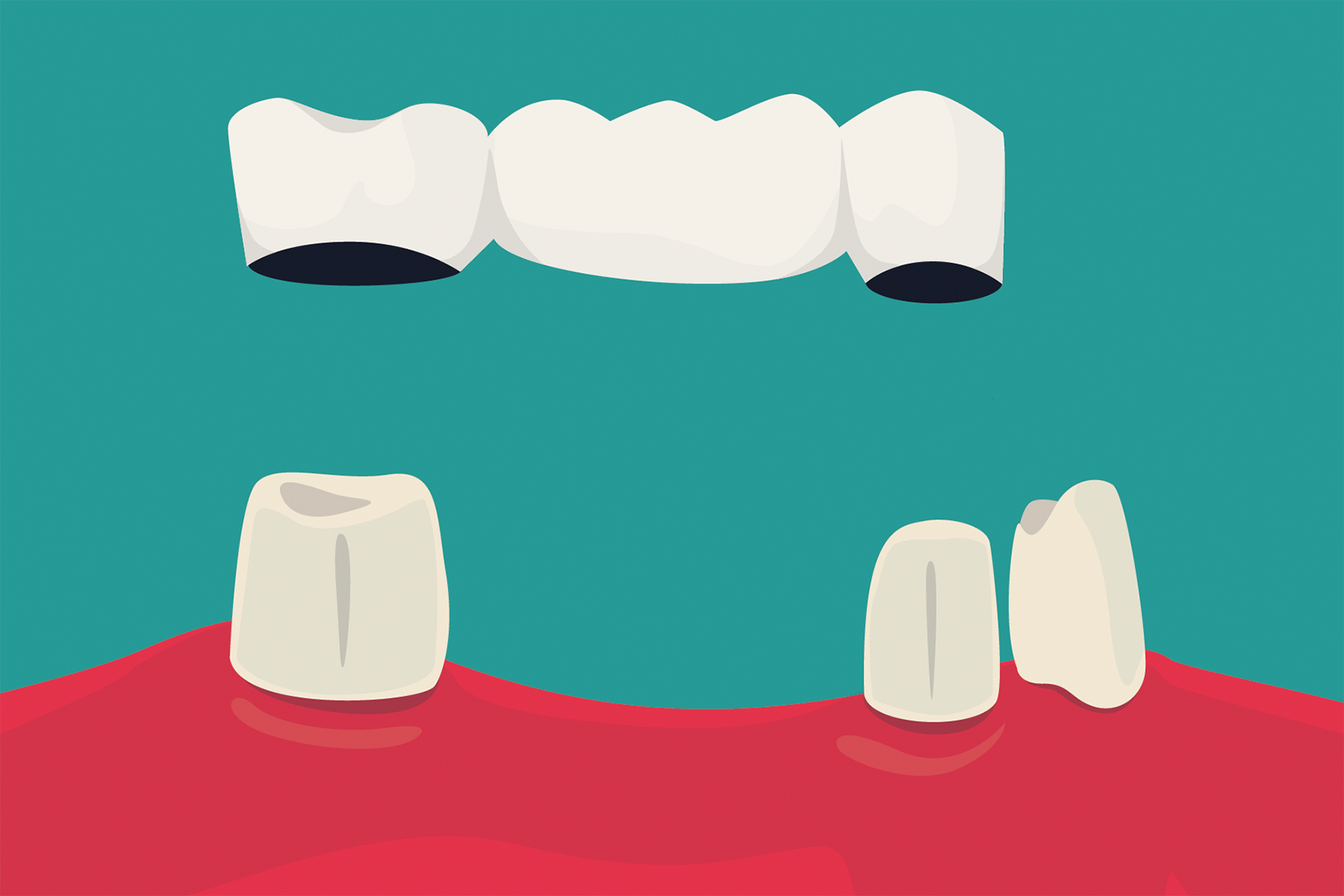
A crown is for a tooth you still have: a cap, made to measure, that fits over what is left of it. A bridge is for a tooth you have lost: a false tooth joined to crowns on the teeth either side of the gap, so three units replace one tooth. A dental implant replaces a missing tooth without touching its neighbours.
What they fix
When each is right, and when something smaller will do.
A crown or a bridge means shaping healthy tooth, so the question is always whether it is needed. These are the cases where it is, and the cases where a smaller repair or a different one is the better answer.
They fix
- A tooth broken or weakened by decay or by a very large filling, before it cracks further.
- A root-filled tooth, which is more brittle without its nerve and needs protecting, often with a post to anchor the crown.
- Discoloured fillings on a front tooth that you would like to look better.
- A bridge or a denture that needs a crowned tooth to hold it firmly.
- One or two missing teeth, with a bridge, where the teeth either side are strong with good bone support.
When it is something else
- A tooth a filling can still hold. A filling, or a porcelain onlay at £375 – £450, keeps more of your tooth and costs less.
- A gap between healthy, unfilled teeth. A bridge means crowning both; an implant leaves them alone.
- Several missing teeth, or gaps on both sides of the mouth, are usually better replaced with a partial denture or implants.
- A tooth just taken out. The gum can take up to six months to heal, so a temporary denture fills the gap before the bridge is made.
- A tooth with an infected nerve needs root canal treatment before it is crowned.
How it runs
Two visits, with the laboratory between.
There are usually one to two weeks between the appointments while the laboratory makes the crown or bridge.
- 1
The plan and the estimate
An examination and an x-ray, the options side by side, and a written estimate and treatment plan before anything starts.
- 2
Preparing the tooth
Numb, then the tooth is reduced and shaped into a core. About 45 minutes for a crown; 45 to 90 for a bridge, depending on the teeth.
- 3
Impressions and shade
An impression of the prepared tooth and its neighbours, one of the opposite teeth to show how you bite, and the shade recorded to match.
- 4
The temporary
A temporary crown goes on so you can use the tooth while the laboratory casts your teeth in dental stone and builds the crown on the model.
- 5
The fit
The new crown or bridge is tried in, checked for fit, bite and look, and fixed with dental cement or adhesive once you and your dentist are happy.
Living with it
Strange for a few days, then it is just your tooth.
A crown is shaped like the tooth it covers, though it may differ a little from the original if that tooth was badly broken, and for a few days it can feel strange. A bridge in a space that was empty feels stranger at first; after the first week the feeling goes. Neither should feel high when you bite. If it does, say so and it is adjusted.
A crown or bridge cannot decay, but the tooth where its edge meets the gum can, and that edge is what decides how many years it lasts. Brush twice a day with a fluoride toothpaste and clean between the teeth with interdental brushes or floss; under a bridge’s false tooth, a bridge needle or special floss does what a toothbrush cannot reach, and you are shown how. Looked after, crowns and bridges last many years; regular check-ups watch the edges.
What they are made of
Four materials, each for a reason.
Where the tooth sits, how hard you bite and how much it shows decide the material. The dentist will recommend one for your tooth and tell you why.
| How it looks | Strength | Where it suits | |
|---|---|---|---|
| Gold | Gold coloured | Very strong and hard-wearing | Back teeth, where it hardly shows |
| Porcelain bonded to metal | Tooth-coloured porcelain over a metal inner layer | Strong | Front or back teeth |
| All porcelain | Tooth-coloured throughout, a kind of glass | Not as strong as porcelain bonded to metal | Mainly front teeth |
| Zirconia | Tooth-coloured | Much stronger than porcelain | Front and back teeth |
The fee guide prices a porcelain crown at £450 – £550, a full gold crown at £650 – £750, and cosmetic crowns, veneers and bridges at £650 – £750; the figure for your tooth is set at the assessment.
What it costs
On the NHS, or privately.
Widney Dental treats NHS and private patients. On the NHS, crowns and bridges are Band 3, £332.10, one charge for the whole course of treatment, including the examination, x-rays and any fillings or root canal done in the same course. The NHS provides the crown or bridge the tooth clinically needs; a choice of material made for looks alone is private. Privately, a bridge is priced by the unit, so the practice’s own example, one missing tooth held by the teeth either side, is three units, £1,500 – £1,650. Under-18s, pregnant women and new mothers, and people on certain benefits pay nothing for NHS treatment.
NHS figures are England’s band charges as nhs.uk publishes them; private figures are Widney Dental’s fee guide. One band charge covers the whole course of treatment.
A missing tooth
Bridge, implant, or denture.
There are three main ways to replace a missing tooth, and which suits you depends on how many teeth are missing, where, and the state of the teeth around them.
| Fixed or removable | The teeth beside it | How long it takes | Cost here, privately | |
|---|---|---|---|---|
| Bridge | Fixed | Crowned, to hold the false tooth | Two visits, once the gum has healed | Three units: £1,500 – £1,650 |
| Dental implant | Fixed | Left alone | Several months, while the bone heals onto the implant | One implant tooth: £1,700 – £2,250, plus the planning |
| Partial denture | Removable | Clasps may rest on them | A few weeks | Acrylic £400 – £750; cobalt chrome £950 – £1,250 |
A bridge is usually the choice where fewer teeth are missing, or the gaps are on one side of the mouth. On the NHS, bridges and dentures are Band 3, £332.10; implants are rarely available on the NHS.
Who does it
Restorative dentists, in one building.
Dr Mohammed Binamin holds the Postgraduate Diploma in Restorative Dentistry from the Eastman Dental Institute and takes a special interest in advanced restorative and cosmetic dentistry. Dr Sarah Lynn won a restorative prize at university and has made restorative dentistry her passion; Dr Damian Panchal graduated with awards in prosthetic and restorative dentistry; and Dr Hayley Freedman’s main interests are minimal intervention and restorative dentistry.
- Dr Mohammed BinaminPrincipal dental surgeon · restorative and cosmetic dentistryGDC 71019
- Dr Sarah LynnAssociate dentist · restorative dentistryGDC 6026
- Dr Damian PanchalAssociate dentist · prosthetic and restorative dentistryGDC 278735
- Dr Hayley FreedmanAssociate dentist · restorative dentistryGDC 252053
What patients say
In their own words.
Tailored treatment plan★★★★★Widney Dental provided a highly professional treatment plan tailored around concerns around my front teeth which I have been unhappy with for years. The treatment plan involved attention to detail, listening to concerns and linking with other professionals to ensure the outcome I desired. I feel so much happier with my smile.
Great support for nervous patients★★★★★I have recently completed treatment for an implant at Widney Dental Care and although nervous at first and some initial discomfort at the beginning the whole process has been managed efficiently and professionally at all times. The care and attention to detail is second to none and the support during and after the treatment is reassuring. I am delighted with my implant.
For the whole family★★★★★My family and I have been receiving treatment at Widney Dental Care for a number of years. I am grateful for the level of care I have received at this practice.
Quality care worth travelling for★★★★★I find this a first-rate practice in every respect. Efficiently run including first-class patient care and treatment. Having moved out of the area several years ago and having full confidence in my dental care and treatment I still remain a patient being more than happy to travel some distance for my dental care.
Google review★★★★★Adam takes great pride in his work, treating the fillings like a work of art.
Questions
Asked before the estimate.
How much is a crown?
Privately at Widney Dental, a porcelain crown is £450 – £550, a full gold crown £650 – £750, and a cosmetic crown £650 – £750; a post, where one is needed, is £150. On the NHS a crown is Band 3, £332.10, for the whole course of treatment.
Can I get a crown on the NHS?
Yes, when the tooth clinically needs one. It is a Band 3 course of treatment, £332.10, and free if you are under 18, pregnant or a new mother, or on certain benefits. A material chosen for looks alone is private.
Are private crowns better than NHS crowns?
An NHS crown is made to do the clinical job properly. What private treatment adds is choice: of material, such as a tooth-coloured crown on a back tooth, and of cosmetic finish. The tooth underneath and how you look after it matter more to how long a crown lasts than which way you paid.
Why do dentists push for crowns?
Because a tooth that is mostly filling, or that has had a root canal, is likely to crack, and a crack can lose the tooth. But a crown means shaping healthy tooth, so if a filling or an onlay will hold, that is the better answer. Ask what the alternative would be; you will be told.
What if I cannot afford a crown after a root canal?
Say so; there are usually options. The NHS covers the crown within Band 3, and on the same course as the root canal it is one charge. A large filling can hold a back tooth for a while, with a higher risk of it cracking, and an onlay costs less than a crown.
Does it hurt to have a tooth prepared for a crown?
No. You have a local anaesthetic and the preparation feels no different from a filling. A root-filled tooth being prepared for a post crown may not need an anaesthetic at all.
How long does it take?
At least two visits: the first to prepare the tooth, take the impressions and the shade, and fit a temporary; the second to fit the permanent crown, usually one to two weeks later.
How long do crowns and bridges last?
Many years, and how many depends mostly on how well they are looked after. The crown itself cannot decay, but the tooth at its edge can, so cleaning that edge, and under a bridge, is what keeps it.
Can a tooth rot under a crown?
Yes, at the edge where the crown meets the tooth, if plaque is left there. That is why brushing along the gum line and cleaning between the teeth matter as much with a crown as without one, and why check-ups look at the edges.
How much is a bridge for one missing tooth?
The usual bridge for one tooth is three units, a false tooth and a crown on each neighbour: £1,500 – £1,650 privately, at £500 – £550 a unit. On the NHS it is Band 3, £332.10.
Is a bridge cheaper than an implant?
At the start, usually: a three-unit bridge is £1,500 – £1,650 against £1,700 – £2,250 for one implant tooth before its planning. The trade-off is that a bridge crowns the two teeth beside the gap, where an implant leaves them untouched. Dental implants sets out the whole cost.
My crown has come off. What should I do?
Keep the crown, keep the area clean, and ring 01564 773080. A crown that fits can often be re-cemented, £47.50 – £57.50 privately, or as urgent care on the NHS. Do not glue it back yourself.
Where are you, and when are you open?
76 Widney Road, Knowle, Solihull B93 9AW. Monday to Thursday 8.30am to 6pm, Friday 8.30am to 5pm. Call 01564 773080, or request a call-back.

Broken, or missing? Rebuilt.
Two visits, made to match, with a written estimate first: a porcelain crown £450 – £550 privately, or NHS Band 3 at £332.10.
Knowle, Solihull
B93 9AW
Friday 8.30am to 5pm