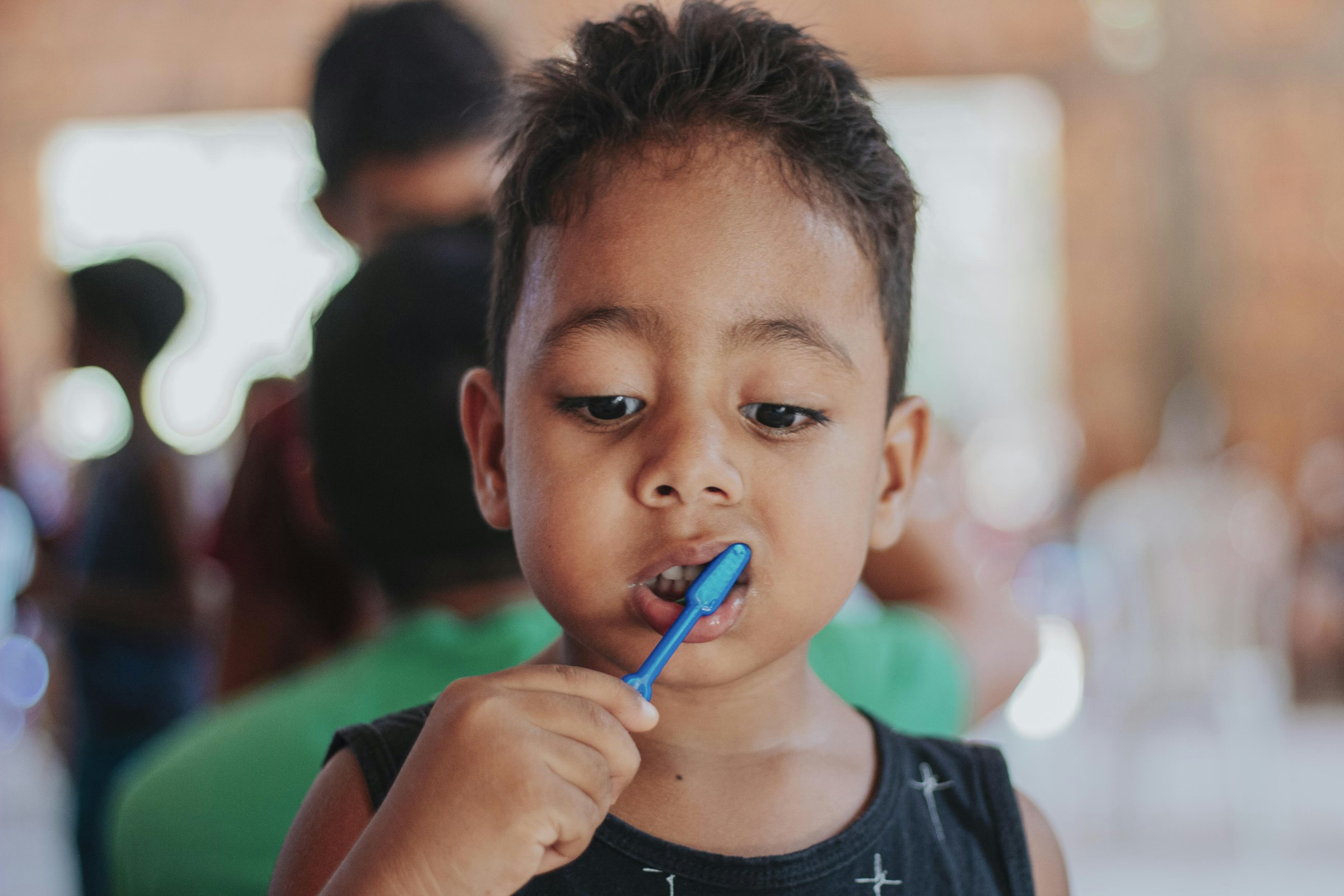
Children’s dentistry · Widney Dental, Knowle
Good teeth start young.
Widney Dental has lots of young patients, and plenty of experience with nervous little ones and children who have never been to a dentist before. Check-ups from the first teeth, brushing shown at the practice, fissure sealants and fluoride when they help, fillings and braces when they are needed. Free on the NHS under 18, and private too.
★★★★★ 4.8 from 175 Google reviews · NHS and private
In short
The younger teeth are looked after, the better.
A child who comes from the first teeth grows up with the dentist as an ordinary part of life, and most of what goes wrong with children’s teeth is caught early or never starts. On the NHS a child’s dentistry is free until they are 18, or 19 in full-time education, and the whole family can be seen at one practice on Widney Road.
What we do, and what you do
Half of it happens here. Half of it happens at home.
The practice offers a full range of dentistry for children, and just as importantly, guidance on diet and tooth cleaning, so your children have the best chance of growing up with the healthiest teeth possible.
At the practice
- Routine oral health assessments, from the first teeth: the teeth and gums looked at, and how they are being cleaned at home talked through.
- Brushing shown, with the right brush and toothpaste for a young mouth, demonstrated at the practice so you can do the same at home.
- Fissure sealants on the back teeth as they come through, and fluoride painted on, where they will help. The sealants page says how.
- Fillings when a tooth needs one, and orthodontics when teeth need moving.
At home
- Brush from the first tooth, twice a day with a fluoride toothpaste, and supervise the brushing until about eight.
- Spit, don’t rinse, so the fluoride stays on the teeth.
- Keep sugary food to a minimum and to meal times, and choose milk or water over fizzy drinks.
- Thumb-sucking is natural for an infant and should stop by two to four; carried on, it can crowd the teeth or change the bite.
How it runs
From the first visit on.
- 1
Book
On the NHS where the practice has a place, or privately. It is never too soon: a first visit before the age of two gets a child used to the room, the chair and the people.
- 2
The first visit
A look at the teeth and gums, a chat about brushing and food, and for a nervous child or one who has never been before, the time to get used to it.
- 3
Brushing, shown
The right brush and toothpaste for the age, and the technique demonstrated at the practice so that it is done the same way at home.
- 4
Prevention
Fluoride painted on, and fissure sealants on the adult back teeth as they come through from six or seven, a few painless minutes a tooth.
- 5
Treatment when needed
A filling if a tooth needs one; an orthodontic assessment, and braces, when teeth need moving. Each is explained to you and to your child before it is done.

What it is like
A routine, not an ordeal.
Going to the dentist regularly from a young age is a good routine for a child to get into, and it gives their teeth the best start. A child who has been coming since their first teeth knows the practice before anything needs doing, which is the point: the nervousness most adults carry comes from a first visit that was already a problem.
The practice has plenty of experience with nervous little ones and with children who have not been to a dentist before. Parents come in too, and the advice given at the chair is for both of you: how to brush, when to stop the dummy or the thumb, and what to put in the lunch box.
What it costs
Free on the NHS until 18.
A child under 18, or under 19 and in full-time education, pays nothing for NHS dental treatment, and a Band 1 course includes fluoride varnish or fissure sealant where they are needed. Privately, the fee guide prices each treatment, and the figures below are its own.
Private figures are Widney Dental’s fee guide, which lists one examination figure whatever the patient’s age. NHS exemptions are England’s, as the fee guide and nhs.uk list them.
Sealant, fluoride or filling
Three things done to a child’s back tooth, set side by side.
Two of them stop decay before it starts; the third repairs it. The order matters.
| What it is | When | How long it takes | Price here | What it does | |
|---|---|---|---|---|---|
| Fissure sealant | A thin plastic coating over the grooves of a back tooth | As the adult molars come through, from six or seven, then eleven to fourteen | A few painless minutes a tooth | £35 a tooth; free on the NHS | Keeps food and bacteria out of the grooves where decay usually starts; lasts years, checked at every visit |
| Fluoride | A varnish painted onto the teeth | At check-ups | A minute | £35; free on the NHS | Hardens the enamel against acid |
| Filling | Decay removed and the tooth filled | When decay has already made a hole | One visit | £95 – £225; free on the NHS | Repairs the tooth; the sealant and the brushing are what stop the next one |
Your child’s dentist says which teeth have grooves deep enough for sealing to help; some teeth form with shallow grooves and do not need it.
Who sees them
The same dentists who see you.
Children at Widney Dental are seen by the practice’s own dentists, so a family can be looked after together, at one practice, by people the children get to know. Dr Sarah Lynn’s dental career began as a dental nurse in 1996 before she qualified as a dentist; Dr Max Turner has practised as a general dentist in Solihull since 2017.
- Dr Mohammed BinaminPrincipal dental surgeonGDC 71019
- Dr Sarah LynnAssociate dentist · restorative dentistryGDC 6026
- Dr Max TurnerAssociate dentistGDC 271187
- Dr Damian PanchalAssociate dentistGDC 278735
What patients say
In their own words.
For the whole family★★★★★My family and I have been receiving treatment at Widney Dental Care for a number of years. I am grateful for the level of care I have received at this practice.
Great support for nervous patients★★★★★I have recently completed treatment for an implant at Widney Dental Care and although nervous at first and some initial discomfort at the beginning the whole process has been managed efficiently and professionally at all times. The care and attention to detail is second to none and the support during and after the treatment is reassuring. I am delighted with my implant.
Quality care worth travelling for★★★★★I find this a first-rate practice in every respect. Efficiently run including first-class patient care and treatment. Having moved out of the area several years ago and having full confidence in my dental care and treatment I still remain a patient being more than happy to travel some distance for my dental care.
Google review★★★★★Adam takes great pride in his work, treating the fillings like a work of art.
Questions
Asked by parents.
Is children’s dentistry free?
On the NHS, yes: a child under 18, or under 19 and in full-time education, pays nothing for NHS dental treatment. Privately, the fee guide prices each treatment; a fissure sealant is £35 a tooth and a fluoride application £35.
When should my child first see a dentist?
It is never too soon. Coming regularly from a young age is a good routine to get into and gives the teeth the best start; a first visit before the age of two is the practice’s advice, so the child meets the dentist before anything needs doing.
My child is nervous. Will that be a problem?
No. The practice has plenty of experience with nervous little ones and with children who have never been to a dentist before. Say so when you book, and the first visit is taken at the child’s pace.
What happens at a child’s check-up?
A routine oral health assessment: the teeth and gums looked at, how they are being cleaned at home talked through, and brushing demonstrated. Fluoride is painted on and fissure sealants placed where they will help, and anything that needs treating is explained to you first.
When should I start brushing my child’s teeth?
As soon as the first teeth come through. Brushes and toothpastes made for young mouths are available, and the practice will show you how; supervise the brushing until about eight, twice a day with a fluoride toothpaste, and have them spit rather than rinse.
How do I protect my child’s teeth from decay?
Daily brushing and good tooth care, and diet: keep sugary foods to a minimum and to meal times, and choose milk or water over fizzy drinks. Fissure sealants on the back teeth and fluoride at check-ups do the rest.
Is thumb-sucking bad for my child’s teeth?
Sucking a thumb is perfectly natural for an infant, and should stop by the age of two to four. Carried on, it can cause crowded or crooked teeth or problems with the bite, depending on how long, how often and how hard the thumb is sucked.
What are fissure sealants, and when are they done?
A thin plastic coating painted onto the biting surfaces of the back teeth, which sets hard and keeps food and bacteria out of the grooves where decay starts. They are placed as the adult molars come through, usually at six or seven, and the rest between eleven and fourteen; it is painless and takes a few minutes a tooth. The sealants page says more.
Does the practice do braces for children?
Yes: orthodontics is part of what the practice offers children. Whether the NHS funds braces depends on an assessment of how much the teeth need moving; where it does not, the practice fits metal braces to both arches for £1,800.
Can my child join as an NHS patient?
Where the practice has an NHS place, yes, and children’s NHS treatment is free. NHS places are limited everywhere in England, so ring and ask reception what is available for your family; private appointments can be booked straight away.
Where are you, and how do I book?
76 Widney Road, Knowle, Solihull B93 9AW. Open Monday to Thursday 8.30am to 6pm and Friday 8.30am to 5pm. Call 01564 773080, or request a call-back.
Bring them early.
A first visit before anything needs doing, brushing shown at the chair, and the back teeth sealed as they come through. Free on the NHS under 18; private appointments booked straight away.
Knowle, Solihull
B93 9AW
Friday 8.30am to 5pm