
Dental implants · Widney Dental, Knowle
Eat what you like, with a tooth that stays put.
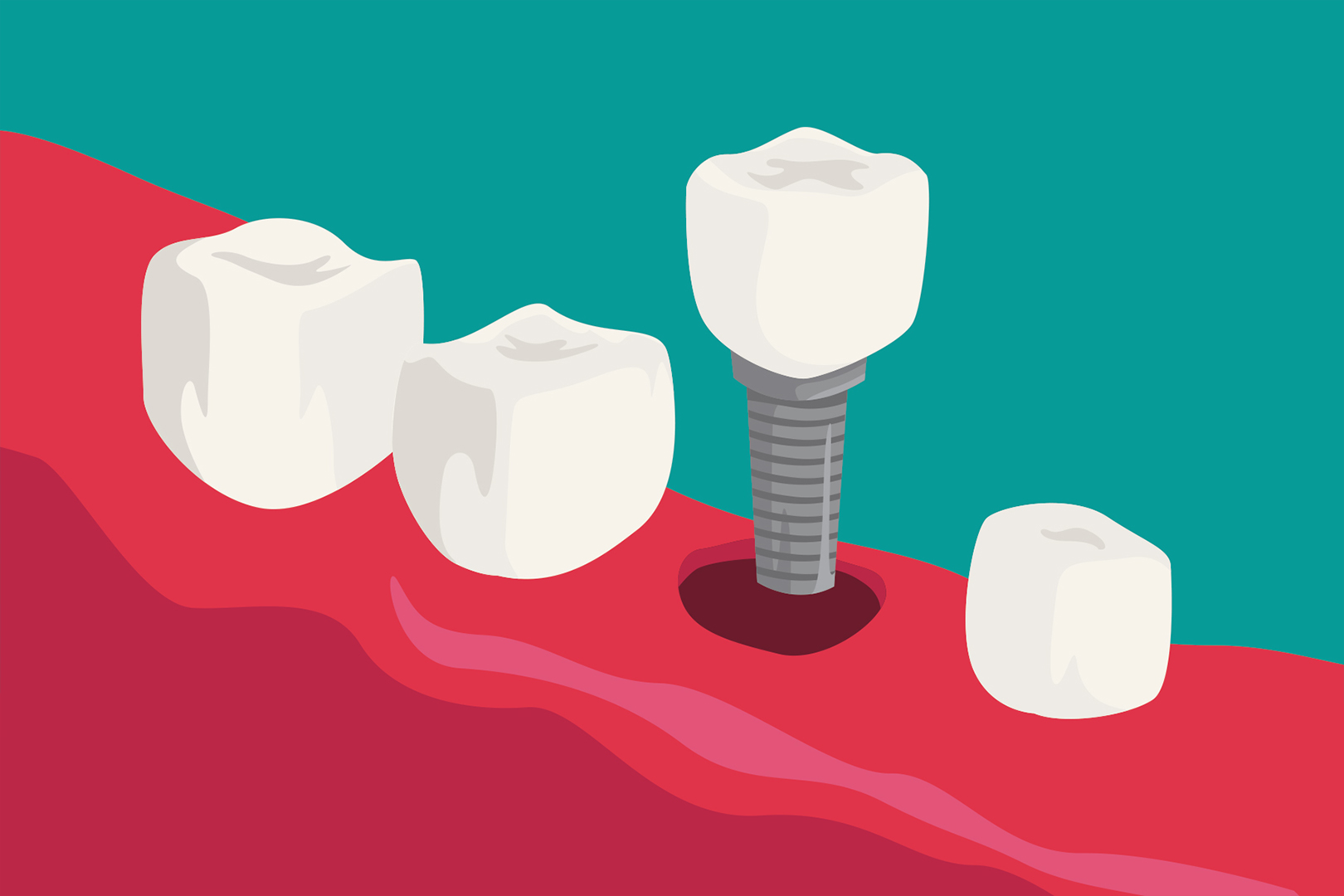
A dental implant is a titanium post placed in the jaw, where the bone grows onto it, with a crown fixed on top: a replacement tooth that does not come out and does not lean on its neighbours. Dr Mohammed Binamin, who holds a master’s degree in implantology, places them here. One tooth, the implant and its crown together, is £1,700 – £2,250, after a £100 consultation.
★★★★★ 4.8 from 175 Google reviews · implants placed and restored in house
In short
Can I have implants?
Most adults who have lost a tooth can, if their gums are healthy and there is enough bone to hold the implant. Where the bone has shrunk, it can often be built up first. Smoking and poorly controlled diabetes make an implant more likely to fail, and gum disease is treated before anything is placed. A 3D scan of the jaw settles the question at the consultation.
What implants do
One tooth, several, or a loose denture.
An implant replaces the root of a tooth, and a new tooth is built on it. Before implants, a bridge and a removable partial denture were the only ways to replace a missing tooth; now there is a third.
They replace
- One missing tooth, with one implant and a crown, and the teeth either side left untouched.
- Several missing teeth, with a bridge fixed on implants rather than on your own teeth.
- A whole arch of teeth, with a full-arch bridge fixed on implants, £10,000 – £15,000 an arch.
- A denture that moves, held firm by implants it clips onto, £4,500 – £6,500.
- A tooth that has to come out, planned so the implant follows the extraction.
What to know first
- Healing takes months. The bone grows onto the implant over a few months before the tooth is fixed on; a temporary fills the gap meanwhile.
- Not enough bone means grafting first: bone augmentation, a block graft or a sinus lift, which add cost and time.
- Gum disease has to be treated before an implant, and kept away after; the hygienist is part of looking after one.
- Smoking slows healing and raises the chance the implant fails.
- A few implants do fail. Most studies find around 95 in 100 still in place after ten years; one that does not take is removed, the site heals, and another can usually be placed.
How it runs
From the consultation to the new tooth.
If you would like to talk it through before a clinical consultation, the practice’s care coordinators offer a free conversation about implants and the alternatives, with no pressure to go ahead.
- 1
The consultation
£100. Your mouth, your gums, your health and what you want, with implants, a bridge and a denture set side by side.
- 2
The scan and the plan
A cone beam CT scan, £100, shows the bone in 3D, and the nerve and sinus it must avoid. Diagnostic planning is £300.
- 3
Placing the implant
Under local anaesthetic, with sedation if you want it. The implant is placed in the bone and the gum closed over or around it. £1,000 – £1,250.
- 4
Healing
Over the next few months the bone grows onto the implant’s surface. A temporary tooth or denture fills the gap while it does.
- 5
The new tooth
An abutment is fixed to the implant and the crown made to match your teeth, then fitted. £700 – £1,000.
What it is like
Less than people expect, and then it is just a tooth.
Placing an implant is done with the area completely numb, so you feel pressure, not pain; for anyone who dreads it, intravenous sedation is available at £175 a session, given by Dr Binamin, who holds a diploma in conscious sedation. Afterwards expect some swelling and tenderness for a few days, eased by ordinary painkillers and soft food, and most people are back to normal within the week.
Once the crown is on, you brush and clean between it like your own teeth and come to your check-ups as usual. The implants used here are from Straumann, Astra, Implant Direct and ETK, established systems with parts that can still be had years from now if a crown ever needs replacing. That is worth asking any practice about, because an implant is meant to be in your jaw for a very long time.
What it costs
Every part of it, priced.
An implant tooth is priced in two parts, the implant placed and the crown fixed on it, so one tooth is £1,700 – £2,250, with the consultation, the scan and the planning before it. Grafting is priced only if your bone needs it, and you have the whole figure in the plan before anything is placed. Implants are rarely available on the NHS: in hospital, for particular clinical needs such as after mouth cancer or a serious injury. For NHS patients here, the NHS routes to replacing a tooth are a bridge or a denture, both Band 3, £332.10.
Private figures are Widney Dental’s fee guide; growth factor adjuncts, where they help healing, are £295 – £495. Where a figure is a range, where you fall in it depends on your case, and you are told before treatment.
A missing tooth
Implant, bridge, or denture.
All three work, and many people are happy with each. The difference that decides it for most is what happens to the teeth beside the gap, and to the bone beneath it.
| How it stays in | The teeth beside it | The bone | Time | Cost here, privately | |
|---|---|---|---|---|---|
| Implant and crown | Fixed in the bone | Left alone | Kept in use by the implant | A few months | £1,700 – £2,250, plus the planning |
| Bridge | Fixed to the teeth either side | Crowned to hold it | Shrinks slowly under the false tooth | Two visits, once the gum has healed | Three units: £1,500 – £1,650 |
| Partial denture | Removable, held by clasps | Clasps may rest on them | Shrinks slowly under it | A few weeks | Acrylic £400 – £750; chrome £950 – £1,250 |
An implant costs the most at the start. A bridge and a denture are also available on the NHS at Band 3, £332.10.
Who does it
Placed and restored under one roof.
Dr Mohammed Binamin trained in implant dentistry at the Eastman Dental Institute, where he gained certificates in surgical and restorative implant dentistry, took a certificate in dental implants at the University of Warwick, and holds a master’s degree in dental implantology from the University of Sheffield. He is a registered mentor with the Association of Dental Implantology, and local dentists refer their own patients to him. Dr Amelia Reed holds a postgraduate certificate in implantology. Two of the practice’s nurses, Sabrina Ahmed and Aroosa Mirza, have extensive experience in implant nursing, and Chontelle Roberts, the head nurse and treatment coordinator, is who to ask about the plan.
- Dr Mohammed BinaminPrincipal dental surgeon · implants, oral surgery, sedationGDC 71019
- Dr Amelia ReedAssociate dentist · implants and restorative dentistry
- Sabrina AhmedDental nurse · implant nursingGDC 147376
- Aroosa MirzaDental nurse · implant nursingGDC 273780
- Chontelle RobertsHead dental nurse · treatment coordinatorGDC 249356
What patients say
In their own words.
First class treatment★★★★★Really first class treatment. Dr Binamin is very easy to work with and very good at his job. I had a major implant procedure undertaken over many months and I am very happy with the outcome.
Going the extra mile★★★★★I lost my tooth in November last year, it was a big upset. The girls on reception were so nice to me, even offered to drive me home. I cannot thank everyone enough and today I have finally got my implant, so pleased with it. A great big THANK YOU.
Great support for nervous patients★★★★★I have recently completed treatment for an implant at Widney Dental Care and although nervous at first and some initial discomfort at the beginning the whole process has been managed efficiently and professionally at all times. The care and attention to detail is second to none and the support during and after the treatment is reassuring. I am delighted with my implant.
For the whole family★★★★★My family and I have been receiving treatment at Widney Dental Care for a number of years. I am grateful for the level of care I have received at this practice.
Quality care worth travelling for★★★★★I find this a first-rate practice in every respect. Efficiently run including first-class patient care and treatment. Having moved out of the area several years ago and having full confidence in my dental care and treatment I still remain a patient being more than happy to travel some distance for my dental care.
Google review★★★★★Adam takes great pride in his work, treating the fillings like a work of art.
Questions
Asked at the consultation.
How much is one dental implant?
At Widney Dental, one implant tooth is £1,700 – £2,250: the implant placed, £1,000 – £1,250, and the abutment and crown, £700 – £1,000. Before it come the consultation, £100, the CT scan, £100, and the planning, £300, and grafting if your bone needs it.
Can I get dental implants on the NHS?
Rarely. Implants are provided on the NHS in hospital for particular clinical needs, such as after mouth cancer, a serious injury, or teeth that never formed. For most people the NHS replaces a missing tooth with a bridge or a denture, at Band 3, £332.10.
How painful is getting an implant?
Less than most people expect. It is done numb, so you feel pressure rather than pain, and sedation is there if you want it. Afterwards there is some swelling and soreness for a few days, which ordinary painkillers usually handle.
How long does the whole thing take?
Usually a few months from placement to the finished tooth, because the bone needs that long to grow onto the implant. Grafting beforehand adds time. The visits themselves are few: the consultation, the scan, the placement, a check, and the crown.
Will I have a gap while it heals?
Not if you do not want one. A temporary denture or bridge can fill the space while the implant heals, and you will be told at the consultation which suits your case.
How long do implants last?
An implant that has joined the bone can last for decades; most studies find around 95 in 100 still in place after ten years. The crown on top wears like any crown and may one day need replacing, which is where an established implant system matters.
How many teeth can one implant replace?
One implant carries one tooth. Two implants can carry a small bridge of three or four teeth, and a whole arch can be fixed on several implants, so you rarely need an implant for every tooth.
What if I do not have enough bone?
It can often be built up. The practice provides the full range of bone grafting: bone augmentation, £450 – £650, block grafting, £850 – £1,050, and a sinus lift for the upper back teeth, £950 – £1,250. The CT scan shows whether you need any of it.
Am I too old for implants?
There is no upper age. What matters is your general health, the health of your gums, and the bone, all of which are checked at the consultation. Many people have implants to steady a denture later in life.
Are implants worth it over a bridge?
They cost more at the start: £1,700 – £2,250 for one implant tooth against £1,500 – £1,650 for a three-unit bridge. What you get for it is a tooth that leaves its neighbours untouched and keeps the bone beneath in use. If the neighbouring teeth already need crowns, a bridge can be the sensible choice.
What does nobody tell you about implants?
That the waiting is the longest part; that an implant needs cleaning as carefully as a tooth, because gum disease around it can loosen it; that smoking works against it; and that a small number fail. None of that is a reason not to have one, but you should know it first.
Can I be sedated?
Yes. Intravenous sedation is £175 a session, given by Dr Binamin, who holds a diploma in conscious sedation. You will need someone to take you home. How the practice helps nervous patients.
Where are you, and when are you open?
76 Widney Road, Knowle, Solihull B93 9AW. Monday to Thursday 8.30am to 6pm, Friday 8.30am to 5pm. Call 01564 773080 to book an implant consultation, or request a call-back.
A gap you are tired of? Ask.
A consultation at £100, a 3D scan, and a plan with every figure in it: one implant tooth is £1,700 – £2,250.
Knowle, Solihull
B93 9AW
Friday 8.30am to 5pm